
China’s Sporting Goods Trade in H1 2025 : exports surpassed USD 14.9 billion
Source:CHINA SPORTING GOODS FEDERATIONRelease time:2025-09-26Clicks:
On July 14, the General Administration of Customs reported that in the first half of 2025, China’s total goods trade reached RMB 21.79 trillion, up 2.9% year-on-year. Exports stood at RMB 13 trillion (+7.2%), while imports were RMB 8.79 trillion (-2.7%).
Sporting goods trade totaled USD 15.581 billion, up 1.20% year-on-year. Exports reached USD 14.901 billion (+1.56%) and imports USD 679 million (-5.91%).
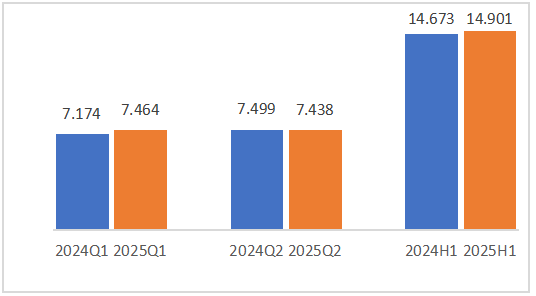
Fig. 1. Sports Goods Exports (H1 2025, USD billion)
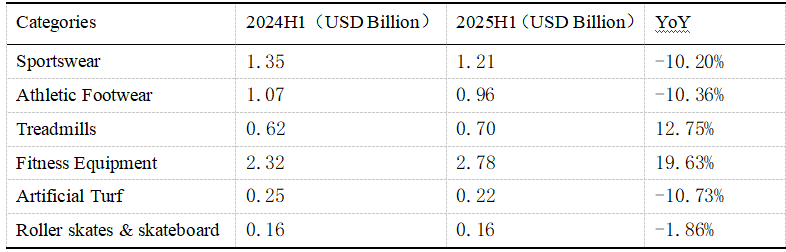
By category, fitness equipment and treadmills were the main drivers, with exports of USD 2.78 billion (+19.63%) and USD 698 million (+12.75%), respectively. In contrast, exports of sportswear, sports shoes, and artificial turf each fell by more than 10%, while roller skates and skateboards declined by 1.86%.
Table 1. Export Value and Growth Rate of Major Sports Goods Categories (H1 2025)
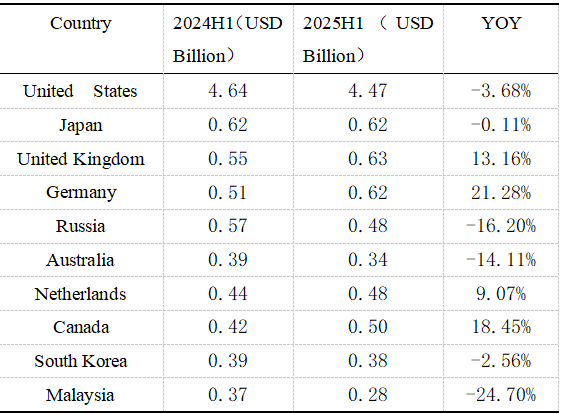
By market, the U.S. remained China’s largest export destination, with USD 4.465 billion in exports, accounting for 29.96% of total sporting goods exports, down from 31.44% last year. Exports to the U.K., Germany, the Netherlands, and Canada grew strongly, reaching USD 627 million (+13.16%), USD 622 million (+21.28%), USD 477 million (+9.07%), and USD 500 million (+18.45%), respectively.
Exports to Japan and South Korea remained stable, edging down 0.11% and 2.5%. Exports to Russia, Australia, and Malaysia dropped sharply, with Malaysia, Vietnam, and Singapore down 24.70%, 9.76%, and 30.13%, respectively.
Table2. Export Value and Year-on-Year Growth Rate of Sporting Goods to Major Partner Countries in H1 2025
Impacted by U.S. tariff hikes, particularly the “reciprocal tariff” trade measures launched in April, exports to the U.S. shifted from 9.62% growth in Q1 to a 15.60% decline in Q2. However, the fall was milder than expected, reflecting the strong competitiveness of Chinese sporting goods. Meanwhile, exports to major Western European markets surged, with growth accelerating in Q2, showing that Chinese enterprises are strengthening their presence in Europe to offset risks in the U.S. market.
Copyright ©2013-2024 CHINA SPORTING GOODS FEDERATION, All Rights Reserved ( 京ICP备05083596号-1 )